The Tournament Engine for Youth Sports
A systems-level redesign of high-volume tournament registration, bulk checkout, and payment architecture across regional and national youth sports leagues.
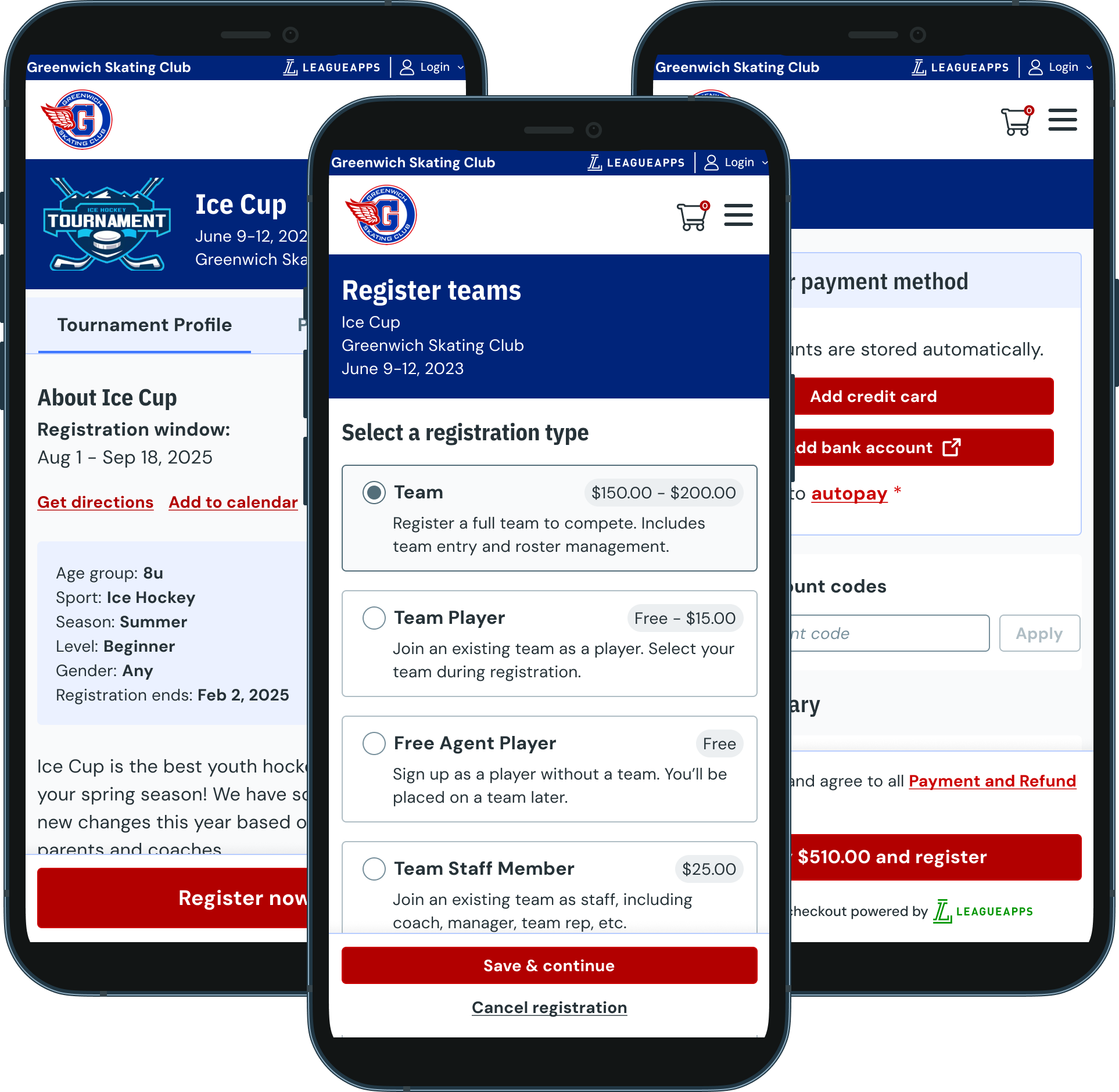
Background
When LeagueApps underwent a company-wide reduction in force, I inherited leadership of two major product squads: Payments and Program Registration. My focus quickly shifted to the tournaments initiative — the highest-priority opportunity to capture share in the competitive youth sports market.
At the time, the platform only supported completing one team registration at a time and lacked mobile optimization. We needed to reimagine the system from the ground up: a scalable, mobile-first experience supporting bulk team registration, complex pricing logic, and seamless payments.
LeagueApps was mid-transition between its legacy (OG) and Next-Gen (NG) platform architectures. Data synchronization between the two environments introduced real complexity — requiring surgical precision in both design and engineering decisions at every step.
Users & Context
The LeagueApps ecosystem serves a diverse set of users, each navigating different workflows, responsibilities, and levels of technical comfort.
- Configure divisions, pricing, and roster caps
- Manage waitlists and compliance flows
- Register returning teams on behalf of coaches
- Export data for compliance and reporting
- Register multiple teams quickly in the field
- Select payment plan and complete checkout
- Manage roster on a mobile device
- Receive clear confirmation and receipts
- Register a child without confusion
- Complete payment quickly and securely
- Receive clear confirmation of registration status
- Demo capabilities to enterprise prospects
- Escalate organizer pain points quickly
- Support partners during high-volume events
Internally, I worked across two product squads and multiple stakeholder groups — customer success, sales, and engineering. These cross-functional collaborations were essential to translating business priorities into a coherent user experience.
Problem
How do we transform a fragmented, one-at-a-time registration system into a scalable tournament engine — without disrupting the ongoing OG-to-NG platform migration?
Tournament organizers and registrants alike struggled with a fragmented and inefficient registration process. The pain points fell into five categories:
From a business standpoint, these shortcomings limited LeagueApps' ability to compete in the tournament software market — a space dominated by mobile-optimized, streamlined platforms.
Process
Discovery
Research began by analyzing feedback from recorded customer success and sales calls in Gong, then synthesizing insights in Dovetail. I facilitated assumption-mapping workshops and prioritization exercises to validate what we believed we knew about our users.
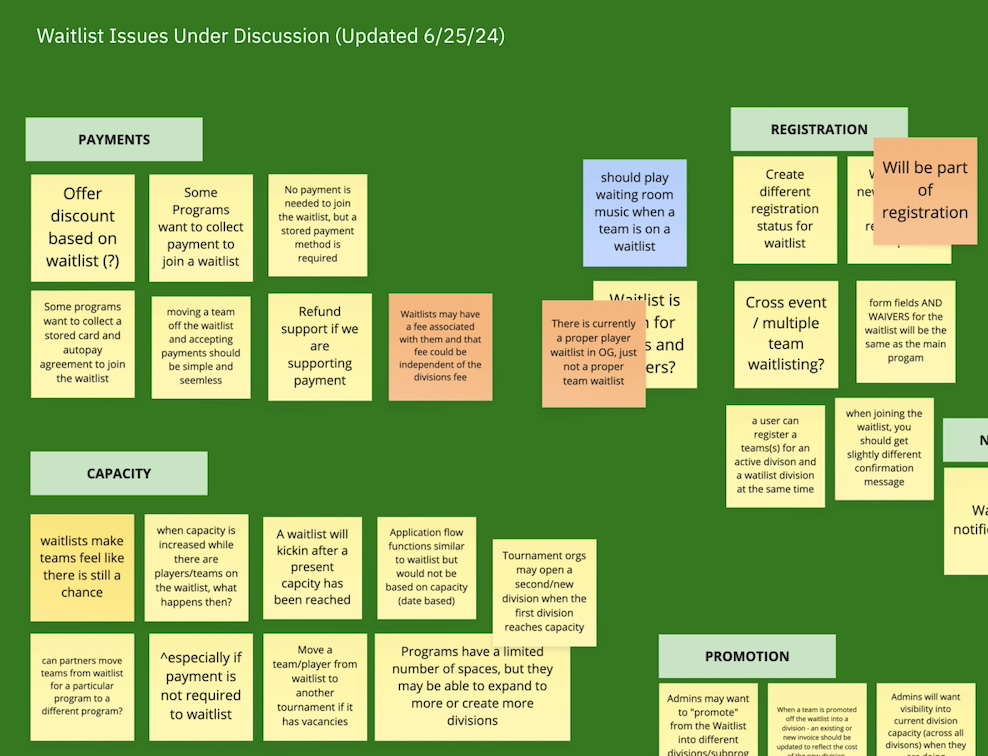
Assumption mapping artifact from a waitlist prioritization workshop — used to surface hidden risk and align the squad before committing to design direction.
We interviewed over 20 tournament organizers plus a handful of parents and coaches. One surprising insight: organizers frequently registered returning teams on their behalf — a clear signal that the registration flow was too time-consuming for busy coaches and staff.
Key Insights
- Bulk registration was the single highest-impact capability missing from the platform
- Flexible pricing models and payment plans were requested by nearly every organizer interviewed
- A native waitlist system was missing but highly requested — most partners had built manual workarounds
- Tournament caps (by team or player count) needed to be configurable at the program level
- Mobile-first was non-negotiable — nearly every critical action happened on a phone, on a field
Design & Strategy
With these insights, I restructured the experience around scalability and reuse — not just patching existing flows, but rearchitecting the registration model.
Collaboration & Handoff
I led design reviews across both squads, presenting work twice monthly to leadership and weekly to engineering. During handoff, we used boxing exercises — structured working sessions mapping each UI element to its backend endpoint — to catch mismatches early and keep velocity high.
Feedback loops were tight: constant iteration between Figma prototypes, Jira tickets, and in-progress demos kept all parties aligned without heavy documentation overhead.
Testing & Iteration
I moderated prototype walkthroughs at key decision points. The most significant early win came from a single microcopy change.
Registrants were entering parent information where tournament administrators expected child information. One field label update nearly eliminated the error entirely.
— Usability Test Finding, Tournament Registration FlowThese iterative test-and-learn cycles transformed stakeholder understanding of user testing's value — leading to broader adoption of unmoderated usability testing company-wide.
- Bulk team registration cart
- Mobile-optimized checkout
- Roster cap configuration
- Fieldhouse DS application
- Dynamic payment plan builder
- Native waitlist management
- Position-based pricing logic
- Automated compliance flows
Outcome
The previous solution could take a single organizer over 8 hours to register the same number of teams. The redesigned experience compressed that to 30 minutes — a 16× improvement in throughput for high-volume events.
Beyond registration, the tournaments initiative created a roadmap for future extensibility into memberships, e-commerce, and add-ons — establishing a scalable architecture that future teams can build on.
Reflection
- Cross-squad design reviews built alignment fast
- Boxing exercises caught integration gaps before dev
- Incremental NG debt reduction prevented rework
- Microcopy testing produced outsized impact
- Map the full program ecosystem earlier to surface cross-program redundancies
- Prioritize an IA overhaul alongside the visual redesign
- Involve CS earlier in waitlist notification design
This project reinforced the importance of balancing deep collaboration with design autonomy. While constant communication across squads was time-consuming, it built the trust needed to move fast during a critical product transition.
I also learned firsthand that mobile-first thinking is non-negotiable in youth sports. Nearly every critical action — from roster checks to payments — happens on the field, on the go, under pressure.
The Tournaments initiative modernized a core LeagueApps product and catalyzed an organizational shift toward scalable, design-led systems thinking — one that continues to shape how new programs are conceived.